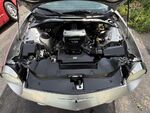
I am making this thread because the lack of information out there as it pertains to the 2003-2005 Ford Thunderbird that was fitted with the Jaguar 3.9 DOHC V8 engine. This engine was also used in the Lincoln LS of that era, along with many of the V8 Jaguars.
Since Ford owned Jaguar at that time, it makes sense. It also explains why the Thunderbird and the Lincoln LS back then we so damn fast/quick.
We took this vehicle in last year for a complaint of a small coolant leak that appeared to be coming from the coolant tank which is mounted at the rearward area of the engine on the drivers side.
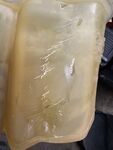
Upon removal of the tank we did find some hairline cracks
Everything was fine for awhile after replacement however towards the end of the season last year it started leaking again, this time the leak was quite large and seemed to be coming from under the intake manifold
rolling down across both sides of the transmission bell housing. Using a bore-scope I was able to see the coolant rolling down from under the drivers side area under the intake but that is all you could see was movement of
the coolant, not where it was leaking. It was of course also leaking on the passengers side under the intake and rolling down the passengers side bell housing also -- however this engine is shoe-horned in there so tight I couldn't
get the bore-scope down on the right passengers side to even see under the intake manifold!
I searched high and low for diagrams or photos under the intake manifold but there is VERY LITTLE information out there that shows clearly what is under the intake -- even in manuals!
So I decided the intake manifold had to be removed because something under there was leaking. On the internet it claims that the plastic coolant elbow under the intake is a common leak area
as it has two o-rings at it's connector ends, and the elbow itself is plastic. I was able to get my bore scope down in the front of the engine and did not see anything leaking from either end
of the coolant elbow where it connects! So I had no choice but to pull the intake!
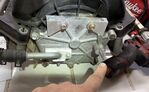
The intake manifold is not easy to remove, and requires a lot of unhooking electrical connections. My recommendation is to remove the two bolts holding the EGR valve to the throttle body first,
then pull it back a little and remove the throttle body itself. Once the throttle body is removed you will see the plastic coolant elbow, and as the bore scope showed -- it was not leaking!
Thus I had to remove the rest of the intake to see what the heck was leaking under there! This is pretty straightforward except there is one 10mm nut holding the harness loom on the back side you have to remove in addition to the two
on the back top side that also require you to use and inverted Torx bit to remove the studs. Once this is done the EGR can be left in place after you unhook all the electrical connectors to the fuel rail and intake.
If everything is disconnected the intake slides out fairly easy, just use extreme caution while working it out.
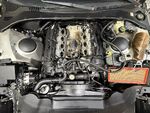
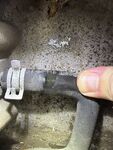
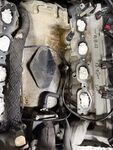
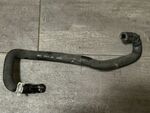
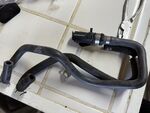
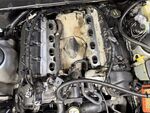
At this time you will probably see the problem, which on this job was a small bypass hose going to the neck where the coolant elbow attaches to the engine, up to the coolant hose barb on the throttle body!
It just cracks and starts leaking in the valley of the engine, then rolls back down under the intake and down the transmission bell housing.
And that little hose is where the leak under the intake manifold comes from! I'm sure the plastic elbow that mounts just above it can leak, or become cracked -- but it wasn't in this case.
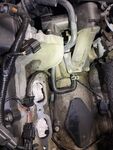
I'm going to strongly recommend replacing the elbow (part shown above with four bolts holding it to the engine block in the valley) while the intake is off.
The part number for the hose is 3W43-9F814-AB and wouldn't you know it's obsolete, or NLA from Fords currently. I'm going to do some checking on the Jaguar end -- but I wanted this information out there
because I had so many problems trying to find ANYTHING out there in terms of photos or accurate information on this issue.
I'll report back with what I find for aftermarket and or Jaguar options for the hose above... but for now I hope these photos help others with a similar leak on a 2003-2005 Ford Thunderbird, Lincoln LS or even a Jaguar if they too are the same with
I'm updating this thread to say that as of today's date the hose shown above is NLA (No longer available).
I'd also like to mention that in my research I keep hearing about this engine being a Jaguar engine, so I decided to see if perhaps I could buy the hose through Jaguar.
In my exploration into the Jaguar version of this engine I have learned the following -
-- The Jaguar version of this engine is larger in displacement. The Jaguar version is 4.2 liters rather than the 3.9 liters found in the Thunderbird and Lincoln LS.
-- The engines are VERY similar in terms of the long-block and plastic intake manifold design, however they do not use the same throttle bodies, EGR valves and other attachments.
-- The hose that Jaguar uses is similar to the one above but different enough to where it won't work. For example the end that connects to the block under the intake is much larger -- and it routes differently because the throttle body plenum is different/longer.
However, the hose is still available through Jaguar for the Jag engine. Makes me wonder why Ford doesn't keep it available as well since the Thunderbird and Lincoln LS are high end vehicles too.
Shockingly, the aftermarket has not picked up on this hose either. Does not seem like much for them to make it, it's only 3/8 hose with a few bends.
I'll also go so far as to say this engine design, both Jaguar and Ford T-Bird/Lincoln remind me more of Ford's DOHC 4.6 Modular Terminator engine... so calling it a Jaguar engine might not be accurate as everyone thinks.
The Ford DOHC Modular 4.6 Terminator engine appeared originally in the late 1990's Ford Mustang Cobra, and the Lincoln Mark VIII...
If you ask me, the 4.2 liter Jaguar engine and the baby 3.8 liter engine found in early 2000's Thunderbirds, Lincoln LS's and even Jaguars is more of a copy of the earlier modular 4.6 Ford Terminator engine.
But that is just my opinion... however it was Ford who purchased Jaguar and not the other way around. Ford also cleaned up decades worth of wiring problems that Jaguar had also.
In my case with this Thunderbird I am considering buying the Jag hose to see if it can be modified. If not I'm going to repair the old hose by replacing the damaged portion using a brass 90 degree elbow and a fresh stent of 3/8 hose with some quality clamps.
It's all I can do for now to get her back on the road. I'll keep you posted.
Figured I'd update this thread with the final results so that anyone reading will have the final details...
Turns out the Jaguar hose works good if you modify it. The vehicle is back on the road and already turned over 5,000 miles!
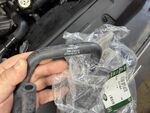
So I picked up the hose shown above from the Jaguar dealership. They had to order it in from the warehouse, but unlike Fords -- at least Jaguar still carries the hose.
In this photo above you can see the new Jaguar hose set right next to the original Ford hose. You have to use a sharp razor blade to cut the adapter fitting off just behind the silver band clip so that it will fit on the nipple in the valley.
Here the hose is trimmed and installed. It's almost a near identical match.
This photo above shows the intake valley and intake ports on the heads cleaned up for re-install of the intake.
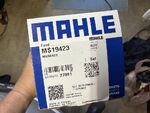
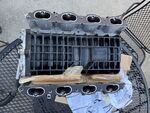
I know I've already been over some details about the intake, but the photo above shows the new gaskets installed. Be sure to buy the OE Mahle metal gaskets because they have little clips that hold them on the intake manifold and it makes it MUCH easier to install without them moving around. You may have to fold the tabs in a little so they fit tight, but once you do that it saves a lot of aggravation!
This is the part number for the metal OE intake gasket from Mahle. It's worth the extra money, as the other gaskets do not attach to the intake and it's tricky enough getting it re-fitted without having to worry about the gasket moving around.
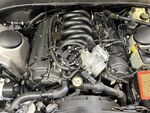
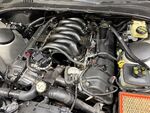
And this is the job completed with the engine cleaned and detailed.
So now you know what to do if your throttle body coolant hose is leaking and running down under the intake and down the transmission bell housing.